
“Something Completely Trustworthy”: Bobby Clennell on Practice, Duty and a Life in Iyengar Yoga
by Mary Talbot
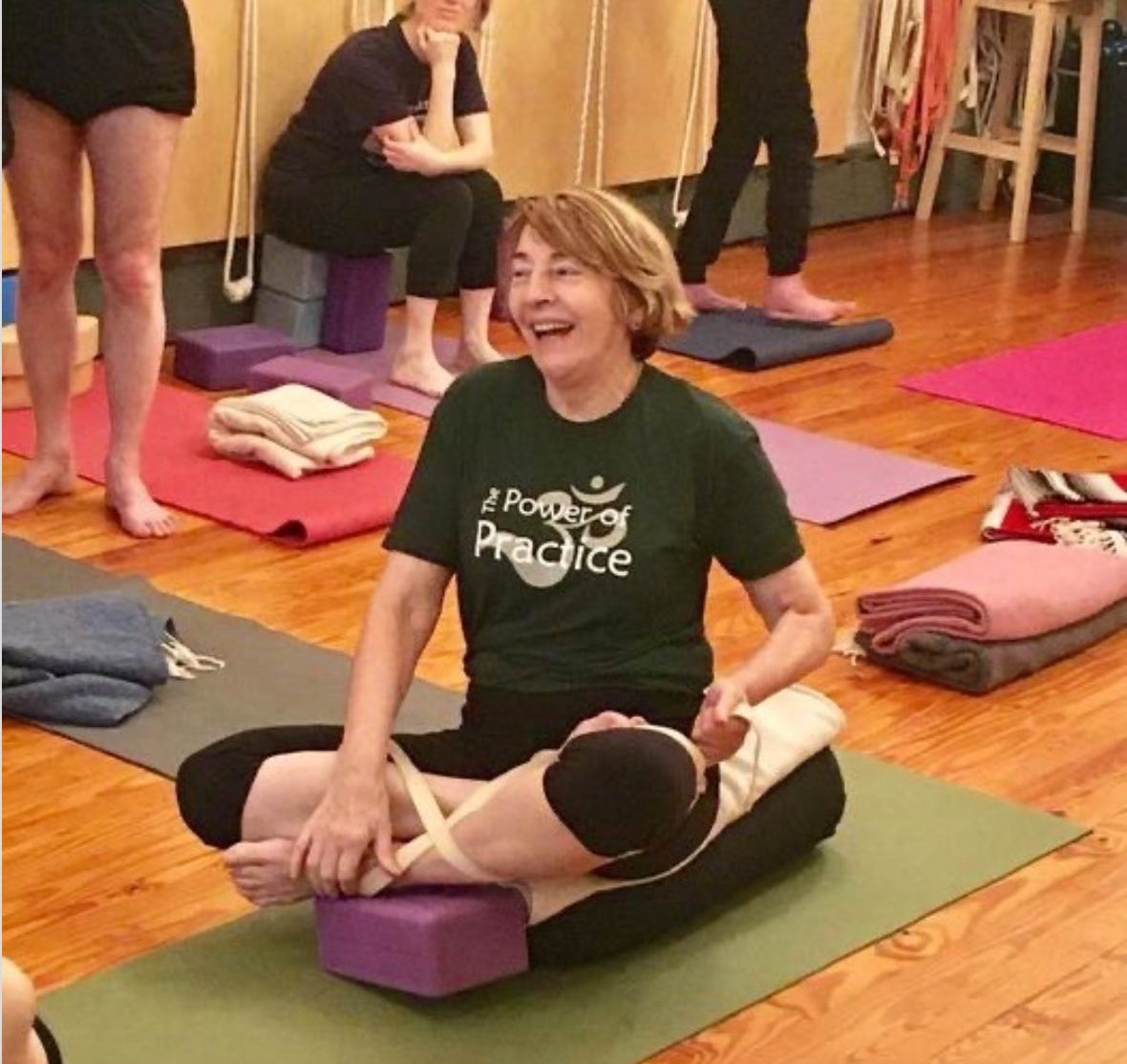
Bobby Clennell is a senior Iyengar yoga teacher, animator, illustrator and author who has taught at the Iyengar Yoga Institute of New York since its inception in 1992 until her retirement this month (March 2026). She’s also the author and illustrator of three beloved yoga books, The Women’s Yoga Book, Watch Me Do Yoga, a guide to yoga for children, and Yoga for Breast Health, in addition to The Pune Guide, an indispensable handbook for yogis studying at the Iyengar Institute in Pune and navigating the city (with details on everything from how to cross the street where to buy sandals and snacks)*. And she has been sought-after leader of workshops who has circled the globe to teach.
Bobby and her siblings were raised by a single mother in struggling post-WWII England and she came of age in the foment of the 1960s and ‘70s, when London was swinging, a crucible of countercultural creativity and social life. By the time she was in her early 20s, she had studied dressmaking at the London School of Fashion, illustration at Central St. Martin’s College of Art and met her husband, Lindsey Clennell, a filmmaker who also would become a Senior Iyengar instructor, at a Scientology meeting. “We were seekers, but we didn’t really know we were seekers,” she says. “We didn’t last in Scientology very long. Maybe we would have been Buddhists, if we’d known what Buddhism was.”
The couple had two sons and supported their young family through the combination of their artistic creativity and resourcefulness. “Lindsey was really creative, I mean really creative,” says Bobby. “He could do anything,” from graphic design and film editing, to collaborating with the avant garde Arts Lab in Convent Garden, to selling central heating systems door-to-door to make ends meet. For a time, Bobby made costumes for the BBC and Pan’s People, the dance group for Top of the Pops, a show that “brought all of Great Britain to a standstill every Thursday night” and she designed clothes for a happening boutique called Bosie, after Oscar Wilde’s lover. “Our apartment was full of women with sewing machines, and dancers, which Lindsey got annoyed about at some point. And in those days, you did what your husband told you to do. So that came to an end, and I started doing animation,” which became a 25-year career.
It was somewhere around 1973 that Bobby and Lindsey discovered yoga in a church hall in London—and it happened to be Iyengar yoga. “I was hooked,” says Bobby, “from the word go. It just made me feel so good.” In short order, yoga became the heart of the couple’s lives—they would save up and travel to Pune to study with B.K.S. Iyengar and his family every two years. “I just felt we had to do it—for the salvation of our family, and mankind, and everything,” Bobby says. “It never occurred to me we were ever going to become yoga teachers. It was that this Mr. Iyengar was so extraordinary.” Iyengar yoga gave her, she says, the strength to navigate a dramatically shifting world for women—“the framework with which to move forward in life.” It was “something completely reliable and trustworthy.”
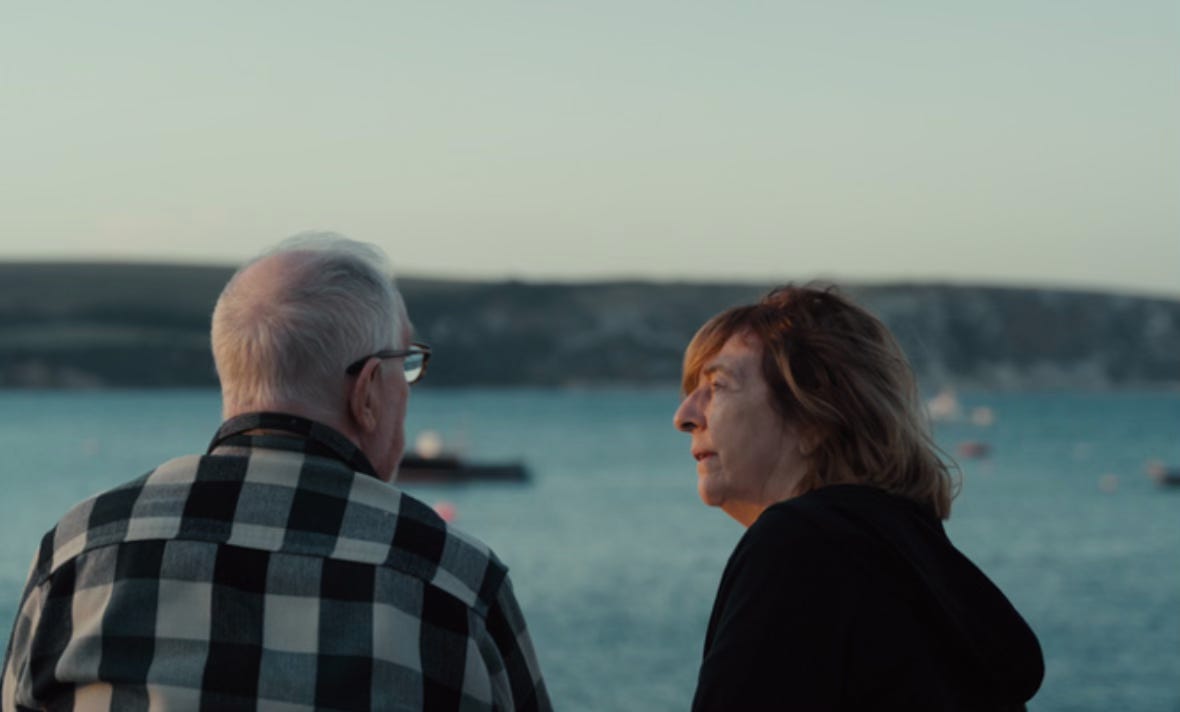
A few years ago, Lindsey was diagnosed with Alzheimer’s. In addition to her teaching, workshops and other responsibilities, Bobby became his caretaker. In September, after more than three decades in New York City, the couple moved back to England, where their son Miles lives and where they own a house. This interview was conducted on the cusp of that turning point, as Bobby reflected on her time in New York, 50-plus years in Iyengar yoga and her hopes for a future with more time for personal practice and introspection. “I want my mornings back, I want my pranayama. I think that’s right for 82.”
Let’s start with a question about your beginnings. Was there anything in your childhood that was a glimmer of your future life as a yoga practitioner and teacher?
Not exactly. I was never athletic or a sports person. I was brought up mostly by a single mother. I had a father, but he died when I was 10, and he hadn’t been at home, anyway. My mother had nothing, except to get up and go to work, and bring us up, and get us educated.
I was born two years before the war ended so I don’t remember it, except for uncles showing up in uniform, and bomb sites everywhere. But my mother lived through the war and bringing us up in post-war England, when there was rationing and the country was just pulling itself together was a bit of a grim time. My mother was under a huge amount of stress, and I don’t think she could see the magic in me, or my siblings, really, bless her. She loved us a lot, but she didn’t have any backup, any help. She taught me how to put one foot in front of the other. That still stays with me. I’m a living testament. It worked out.


But when I was six or seven, my mother took me once a week to a dance class for little girls on Girdlers Road in Hammersmith, London. My dance teacher was called Miss Greenwood, and I loved Miss Greenwood and dancing. And then, one day—they didn’t consult me, or anything—she just left. As teachers do. I tell my students, “Look, don’t hold onto me, let me go.”
Anyway, Miss Greenwood, who taught ballet, left and this other teacher came, who seemed to be more Isadora Duncan, which I thought was horrible. And so I just stopped going. I just refused. I was not going to go back again. It’s amazing how important these things are to us.
But you had enjoyed the physicality and moving your body?
Yes. And eventually, the yoga replaced the dance classes, because I had a memory of being in my body, and moving, and being with a teacher and a group of other people doing it, and it being a sort of art form. I tapped into that when I found yoga.
And how did you find yoga?
A friend told me to come to a class. It was Carol Rudd. Thank you, Carol! Some of the hedonistic aspects of the sixties were sort of winding down, the Beatles were going to India, and everyone started getting interested in India. The class was being taught in a church hall by a guy called David Elliott, who’s now passed away. From the very first class, I just felt so good. I was hooked, from the word go.
Lindsey used to come with me. We would do it together. I must have been around 30, because around 32, we went to India. It was, “Let’s go and find out what this is all about.”
Lindsey went first, just to make sure it was ok. It was like going to Mars as far as we knew. The amazing thing is that he happened to be there for the grand opening of Ramamani Iyengar Memorial Yoga Institute (RIMYI). I don’t think we understood the significance of that, what a big deal it was. And Krishnamacharya, Iyengar’s guru, was there, but I’m not sure that the penny dropped about that either.
So, Lindsey gave the thumbs up?
Yes, I went a year later, and it was like, “Oh my God, this is amazing. You’ve got to be kidding!” (Although I would never have said those words—that’s an American way of talking.) And after that, it was every two years. We’d save up, and then we’d go. I’d never met anybody like Mr. Iyengar, who was such a humanitarian, so selfless, so generous.
You hear people talking about how rough he was, and how he shouted. And he could be scary. I mean, you weren’t going to have a casual conversation with him. He was a realized being.
Anyway, we just kept going back and back and back. It was just an intuition that this was incredibly important.
Can you describe what those first experiences in Guruji’s classes were like?
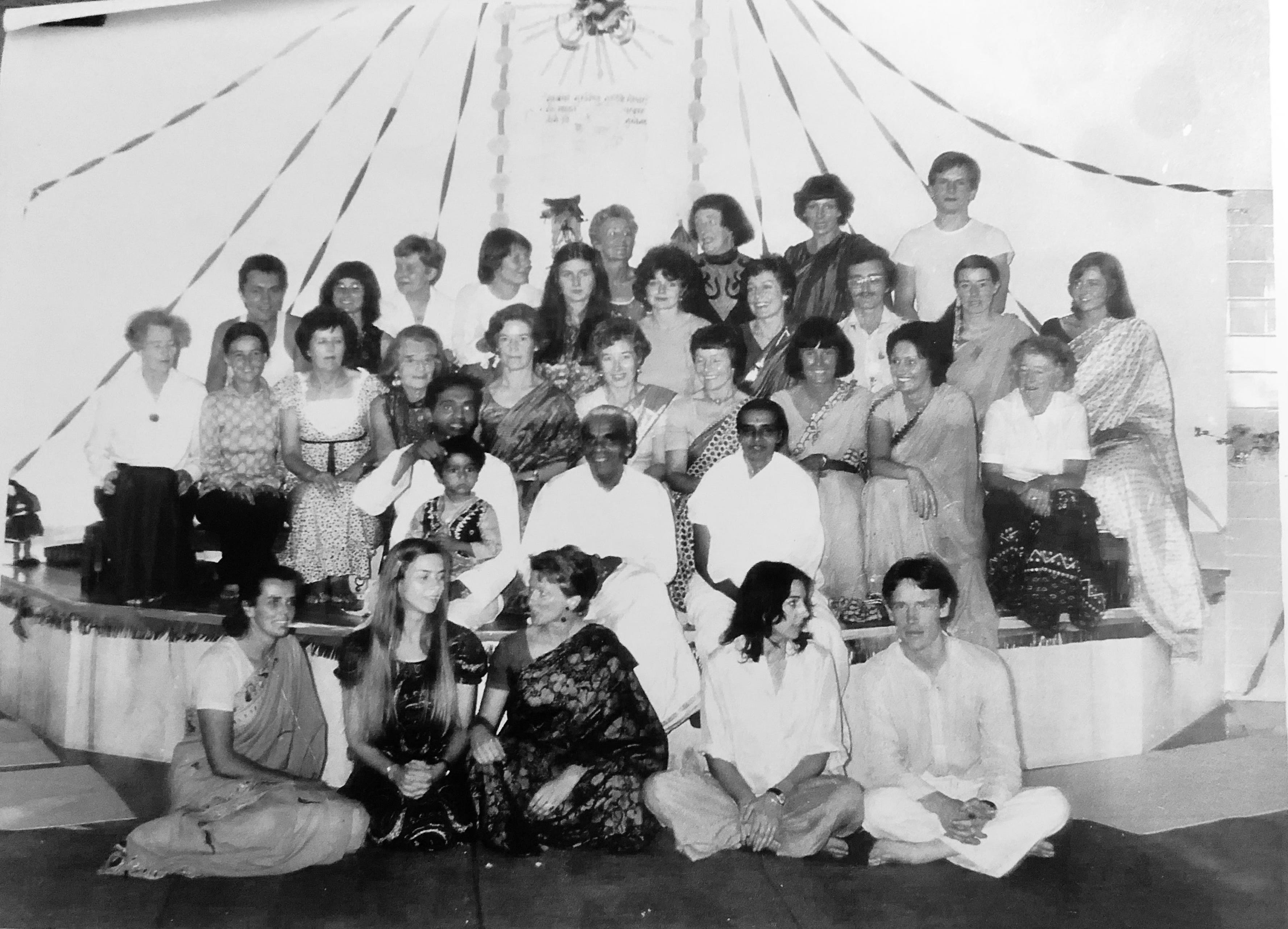
Well, we thought we’d been really practicing in England. Until we went there. We were young, and we survived, but I could not walk up the steps of the Ajit Hotel after class. Lindsey would have to push me up. And now, I’m grateful that I got that imprint in there when I was as young as I was, and built up the physical strength, and every other kind of strength that goes with it. Guruji was so insistent. He kept you on the edge of the moment.
When he was present, the room changed. If he was over there practicing, like during the general practice sessions we had every day, you became more focused. And if he wasn’t there, it wasn’t the same. But if he was somewhere in the corner, something happened to the atmosphere.
What did that feel like?
Well, your practice sharpened up. Even if you thought he couldn’t see you, of course he could see you. He knew what was going on. You came more into present time, and you just wised up. You became the best person you could be in that circumstance, which was as yoga practitioner. There was no laziness about your practice, and it was very important to you.
That was something else you learned from him—that practice is very important, and we should practice regularly, and with integrity. He had such an eye for detail, and there was nothing else going on with him. That was the thing. I think he used to watch the cricket on TV, but other than that, I can’t remember him doing anything else besides yoga.
And did you notice the effect it was having on you?
It gave me strength. It meant I could cope with a changing world for women. There was a lot of stuff going on. Feminism came our way around about that time, but I wasn’t born into feminism. I was still a kind of a ‘50s kind of a person, albeit very young. And then, drugs suddenly appeared out of nowhere. You never saw marijuana before. And all those ‘60s and ‘70s ideas were brand new.
It was a lot of change, a lot to navigate, especially, if you were a creative, like me and Lindsey. We didn’t have degrees, we weren’t working in steady jobs, we didn’t have a career path. So, you have to have something to hold onto, something that says, “This is something you can trust.” Guruji was the most trustworthy person I ever met.
Which is noteworthy when so many people saw their gurus go under.
Right, a lot of other gurus were disgracing themselves and getting tempted. Who wouldn’t, with all that adulation coming at you? But he didn’t seem to be affected at all.
You’ve also described how his physical appearance and activities changed after your first meetings and that, when he was traveling, he wore beautiful suits and wanted to see the latest movies—which is hard to imagine for those of us who came to know of him during the last decades of his life.
Well, we had nothing to compare him with at the time, and we didn’t question it. It was such a new experience for us. He would get his suits made by tailors in London, and had a short haircut, and he’d ride around on a motorbike. He was often trying to get the motorbike to start, and then he’d go off. He was eating Western food and meeting Western people. And he was “sir,” you called him “sir.” But he still had all his integrity, even if he did have a suit made on Savile Row.
But yes, then he did change. I can’t remember what year. He grew his hair and started wearing simple Indian-style shirts. And he had certain stones that he wore. In Pune, there would have been a Vedic astrologer around to tell you which ones. And you referred to him as your guru. He was Guruji now, and he embodied that.
Over the decades you studied with and observed him, how did you see his teaching, or the focus of his teaching, evolve?
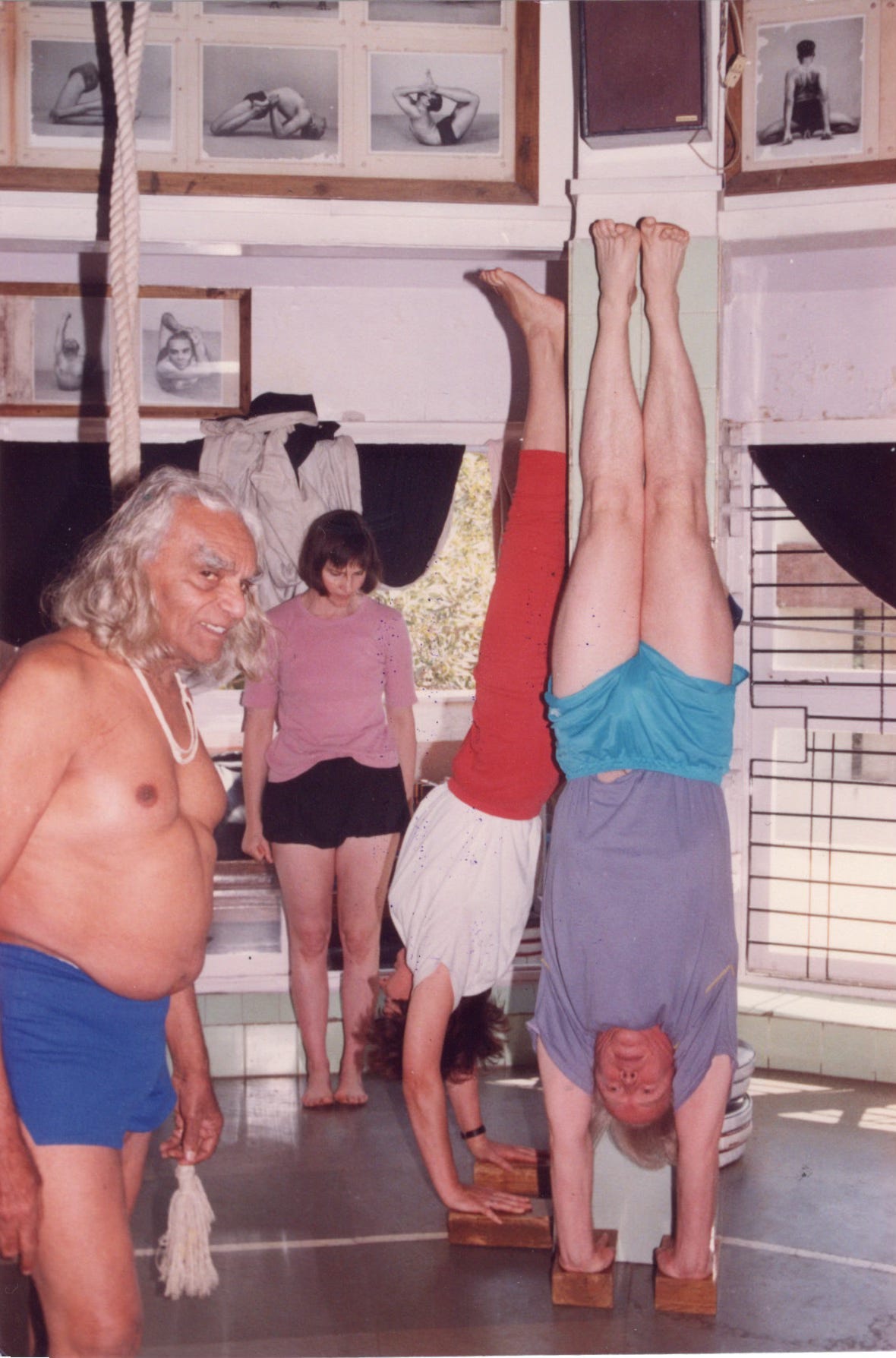
I think his teaching kept evolving the whole time. He taught in the moment. He used to say, “Don’t do the same pose twice. This is your first trikonasana ever. Don’t do the one you did yesterday.” He also used to say, “There is no such thing as Iyengar yoga. It’s yoga, it’s not Iyengar yoga.” But it was—it all came from him.
Lucky for us.
That’s right.
Can you describe your experience of that evolution?
I think the UK was one of the first Western countries Guruji came to. Yehudi Menuhin was his student, and he was living in England, so Guruji started coming to teach. At the time, there was a thing called the Inner London Educational Authority—ILEA. They taught evening classes in school buildings, where people could learn basket weaving or whatever, in the classrooms at night. And they decided to include yoga.
By some miracle, or karma, someone said, “If we’re going to do yoga under the auspices of the ILEA, it’s got to be Iyengar Yoga.” And somebody else said, “Okay, we’ll have Iyengar yoga. But no weird stuff—no chanting, no spirituality, no philosophy. None of that.”
So, the way Guruji taught came out of that. It was on a physical plane, and in great detail. But there was no talk of chakras or the scriptures. This was part of the development of his teaching, and why it’s so precise, and why Iyengar yoga teachers are so good at understanding the body.
A long time later, I don’t know what year it was, his teaching did change. There was a marked change. He gave a workshop in [the Indian hill station] Panchgani [for a celebration of his 75th birthday]. And he was talking about elements and koshas [meaning sheaths, which the Upanishads describe as the “subtle body”]. And it was fascinating, and fabulous, and electrifying. It was still asana and pranayama, but a different expression of that.
Guruji explained how once you understand that your subtle body is a collection of memories and impulses that travels from lifetime to lifetime, body to body, you become connected to the infinite. Each lifetime gives you a chance to work off karma and develop spiritually. Knowing that you are not the body, but you have a body—which nevertheless is your temple, so if you do nothing else, take great care of it—and that gives you the chance to step back and see the big picture. Life runs so much more smoothly when you can see the big picture!
Would you talk a bit more about how your relationship to Guruji affected your own spiritual or religious development?
Just being around him and in his class, and being in those practice sessions where you could watch him working with someone—it all had an enormous effect. His attention to detail, and his intense focus on something, on the body, was such a devotional activity. I couldn’t have got that out of a book or anywhere else. So, in that respect, I picked up on a little bit of that focus that he had, just by being inspired by him, by being around someone who is that evolved.
He showed that understanding of how to be your authentic self and not to try to be someone else, to understand what you are meant to be doing—that you have a moral duty to perform, which is your dharma—is all something you might as well stop fighting against and get on with it. When you realize that, then you stop complaining about your lot. That’s leading a spiritual life, I think. I get inspired when I see people who don’t have anywhere near what I have but who still have such joy.
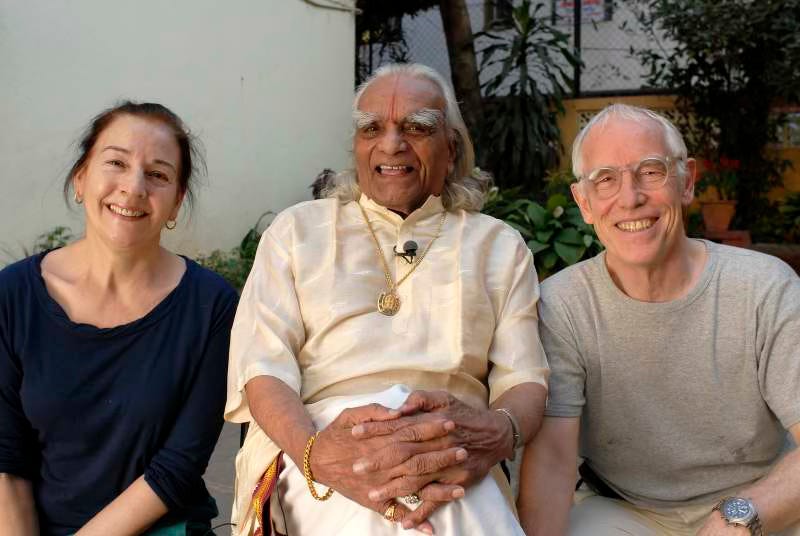
I’ve never met anyone else who cared for people the way Guruji cared for people. That’s a religious life. That’s spirituality to me.
Did Guruji often talk explicitly about yoga as an antidote to suffering?
Well, he said that rather than just running away from suffering or things that are uncomfortable, that facing them, working through them, through the asanas, you become empowered. The asanas empower you, like nothing else I know.
And when you start to feel better—that’s the other thing: you start to feel better—then you’re better able to cope with whatever comes your way. The Vedas and the Yoga Sutras and, Guruji himself, told us, there’s a certain amount of suffering in life and not only does yoga help us face it, but the practice helps us to avoid the suffering that is to come.
And the understanding that there is meant to be joy, too. We’re not actually meant to be suffering particularly—it comes and goes in waves. From this point of my life, I can see that. It’s good to remember that. I think it’s a Tantric saying that describes this: “From joy all beings come. In joy, all beings are sustained. To joy, all beings return.”
Guruji had such a way with words, and so did Geeta. Are there certain things you remember them saying that are almost like a mantra for you, or that pop up at different times of need?
I sometimes find myself repeating a phrase, which might not be that profound, but it’s something that Guruji would say: “Stay there [in the pose], and nothing bad will happen.” (Bobby laughs.)
That’s a good one.
Yeah. “Nothing bad will happen.” My son Jake does a good imitation of that.
And “any amount.” He always said to do something in your practice “any amount”—make every effort you possibly can. There are probably many more things that have just become part of my vocabulary of teaching. With Geeta, it was more of an attitude. I think I remember more of Guruji’s words because I was young and formative when I met him.
Was there a point when the idea of teaching did start to crystalize for you?
Not exactly. Not all at once. One year, we went to Pune with Silva Mehta, who was a teacher in the U.K. [and the late author of Yoga The Iyengar Way]. This was before teacher training. She asked Guruji if he would certify us all. And so he just went round the room and said, “You can be that. You can be that.” I was an intermediate something. Lindsey was more highly certified than me. He was a senior something.
Why was that?
I don’t know but Lindsey did great in yoga. He was really strong. He’d been a gymnast as a kid, he had very strong standing poses, and he was a beautiful practitioner. And when he taught, much later, at the Institute, people always said how wonderful his classes were. He had such a generous spirit.
His classes were wonderful. So that was the beginning of the Iyengar certification system?
Yes, but it wasn’t really a system yet. I had that certification in England, and then when I came to New York, I started teaching at the Institute. And Lindsey wrote to Mr. Iyengar and said, “I think Bobby should be upgraded.” And Mr. Iyengar said, “Yes, all right,” and upgraded me to something. I’m very bad at the levels and things, because I predate it.
So, he upgraded me. And then when I showed up in Pune the next time, all upgraded, Guruji basically said, “Your yoga is crap.” He wasn’t going to let your ego get the better of you. It was just like, “Get over it, lady.” That’s a New York phrase, which he wouldn’t have used. But I just remember him saying something like that, and it was with love.
He wasn’t going to let me, or anyone, get all excited. He was saying, “Keep it going. Don’t rest on that.”
Nevertheless, you were able to put that certification to use when you moved to New York?
Not intentionally, not right away. When we left the UK I kind of lost my identity for a while. I didn’t know who I was, because in England, I was an animator. I didn’t have a work permit or a green card, so I couldn’t work at first. And thank God, that was the end of animation. I mean, I loved animation, but I didn’t want to be an old lady animator.
That’s the period when you made Yantra [an animated film of BKS Iyengar doing asanas]?
Yes, Yantra was sort of my transition from England to New York. I sat and animated Mr. Iyengar doing yoga. I was like a headless chicken, making these line drawings. I couldn’t stop. Animators are funny. They sit in dungeons for years and make a film that may get shown at a festival. So it was in that spirit that I made Yantra, and I wasn’t thinking anything would happen with it. And nothing ever did happen. It’s just on my website.
But the lesson from that is: catch the moment. If you have that energy, catch it, and do it. Don’t overthink. Listen to your intuition. It doesn’t have to be about climbing up a corporate ladder all the time, which I’ve never been able to do anyway.
America made a big impact on me. There was a feeling of freedom in the air that you couldn’t explain. You wouldn’t even know it, unless you come from some place in Europe, or another place in the world. You land here, and there’s just a freedom in your heart that you feel when you move. It may be that’s because you’ve moved out of your own culture into another. It unlocks things in your brain, if you get out of where you were born, and go somewhere else.
So, it turned out that in our 50s, Lindsey and I got another whole lease on life. At home, we would’ve just carried on pootling along, and now you’ve got to survive. We didn’t have any means of [financial] survival, really. So, we had to dig down into our inner resources. And what do you have? Well, I had a teaching certificate. Lindsey was making a film, then he got a job editing, and then he decided he wanted to teach, too.
And so it felt right at that point?
Even though I wasn’t ever meant to be a career yoga teacher, that was what presented itself to me. Geeta used to say, “don’t ask yourself whether it’s what you’re meant to be doing. If you’re doing it, do it. Do it to the best of your ability.”
Maybe there were other possibilities, maybe I should have been an artist or something, but I’m teaching yoga for whatever reason. Geeta also said, “I didn’t choose to teach yoga. Yoga just got me.” Of course, she was the daughter of B.K.S. Iyengar. She could hardly escape. But I don’t think that when she was a child she thought, “I’m going to teach yoga.” And I didn’t, either.
Your teaching career has paralleled the founding and development of the New York Institute. Would you talk a little about your experience of its birth and evolution?
The Institute is home, and it’s why we stayed in New York, in a way. When I arrived, there was no institute—there was a belly dancing place where we used to teach. My son Jake would frog march his friends in and say, “you will come to my mother’s class.” So, it would be mostly Jake’s friends. And then they’d all go to the bar afterwards. And that was my introduction to teaching.
Mary Dunn used to teach at a community center, and Kevin Gardner taught at his apartment. And then Mary started the Institute. What a Herculean task that was—it was a devotional thing she did. And so now we had a home. And at the time you kind of took it for granted, that Mary was this sort of mother. There’ll never be another Mary.
I remember sitting in meetings and befriending Brooke Myers and Richard Jonas. And I was learning how to teach, slowly, because I’d never done teacher training. Mary taught me how to teach without really...I mean, you go to her class, you’re learning how to teach.
It all felt a little bit looser then. Now there’s such a strength about it. We lost our Institute for a while during COVID and then brought it back. I think some of the best teaching goes on there. It’s committed. It has a New York edge.
How did all the international workshops come about?
It was through writing the books and people coming to know me. That’s not why I wrote the books, of course, but it put my name all over the place. The traveling meant I just had to expand to fill this frame. Guruji sometimes said that about yoga: “Make it fit the frame.” By fitting the frame, he meant make the geometric shape of the asana, and then inhabit that shape physically—organs, muscles, nerves—as well as mentally and spiritually.
So, for a while, I was literally on airplanes all the time, and that was so exciting. I really enjoyed it. It was meaningful and I opened myself up to my potential. There’s a bit of a leap of faith to suddenly allow yourself to become a guest teacher all over the place.
And then COVID came, and that was the end of that. As a yoga teacher, to survive you had to change. Some people didn’t get through the change. Some people just stopped teaching.
But because I’d been around film—Lindsey and Jake were film makers, and my eldest son was a video editor, and I was very familiar with live action film as a part of my animation career—it wasn’t too scary. I knew what it means to be in front of the camera, if nothing else.
How would you describe your approach to teaching?
Well, it’s taken an awfully long time to be really at ease with teaching. Partly because for a while I was on the road so much, and the emphasis was more on teaching workshops than the weekly classes. It’s a very different thing. With the workshops, you show up, you wow them, and you leave. You can’t do that with a class because they’re coming back next week.
So, I knew how to teach workshops, but I don’t think I really understood as well how to teach the classes, although I was always teaching classes. I don’t think I’m good at teaching the beginners. I think I kill them, actually.
Your level 1/2 was my introduction to Iyengar over 30 years ago, and I lived to tell the tale.
So, it’s not all bad! Well, I don’t have to rehearse a class like I used to. When I first started to teach, I’d have to write down almost every word I was going to say. And now it’s a list of drawings. I have to draw the asanas, but I may or may not follow that.
I think it takes a long time to learn how to really feel relaxed about teaching and for students to get something out of it. Because it’s not just what you’re doing, it’s how it lands. I think it takes a lifetime of teaching endlessly to get that. But it’s a little less torturous now.
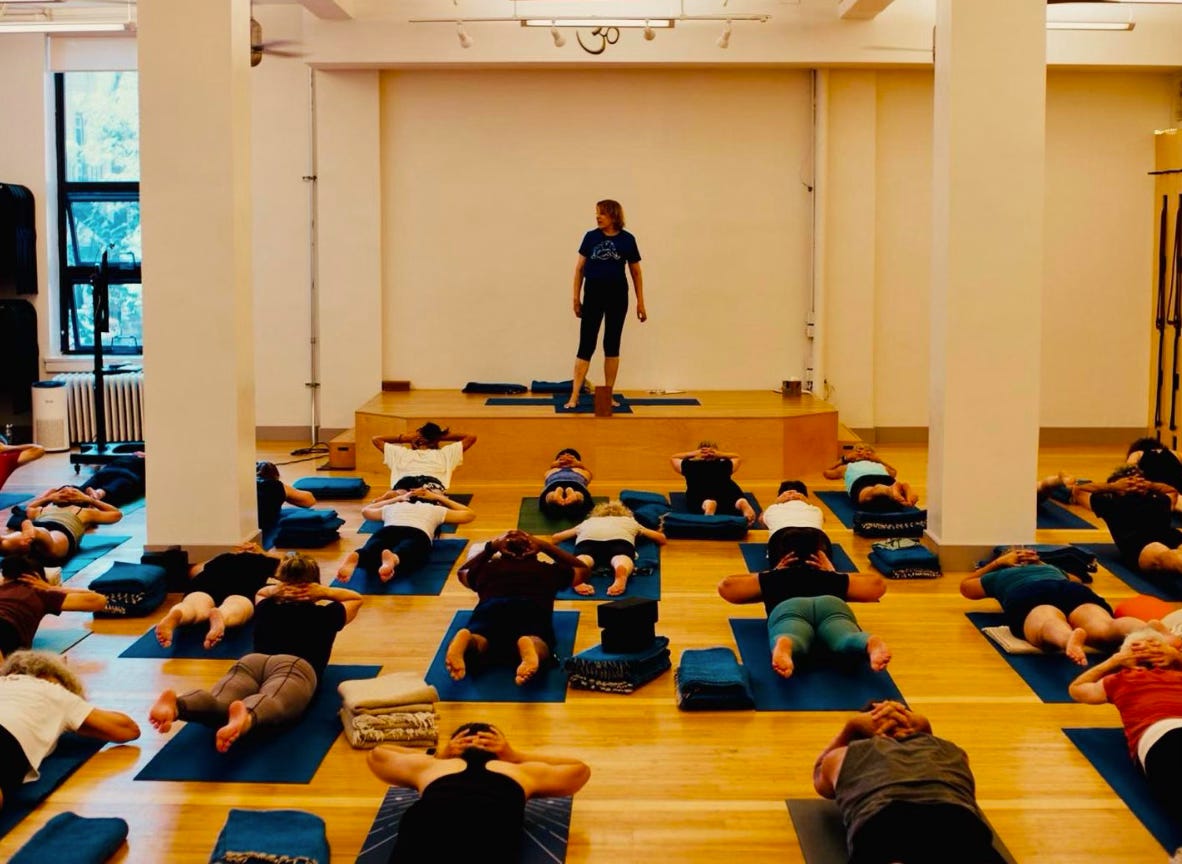
You have to teach according to the level, according to what you’ve learned. But you’re not hiding yourself—students want to see you come through the teaching because it’s a relationship.
But that’s why it’s important that there’s a method—you can’t go wrong because the method is so good. Actually, allowing your own personality to come through can be a bit dangerous, if you don’t have a handle on it. Sometimes I do have to rein myself in and not get too jokey. When I’m tired, I can get very chatty. But the students forgive you.
You’ve illustrated every one of your books, you made Yantra. Is drawing and art making inextricable from yoga for you? Did you start doing that from the very beginning in Pune?
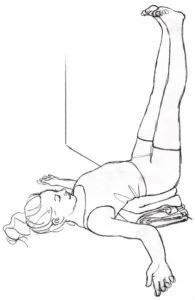
Yes, it was my way of taking notes—but taking notes was frowned upon. Guruji would say, “Don’t make notes, absorb the information through your skin.” But I love my notes. I’ve got files full of them. I don’t think I did drawings in Pune while I was taking a class—it wouldn’t have been allowed—but you were allotted a certain number of classes where you could observe from the back of the room.
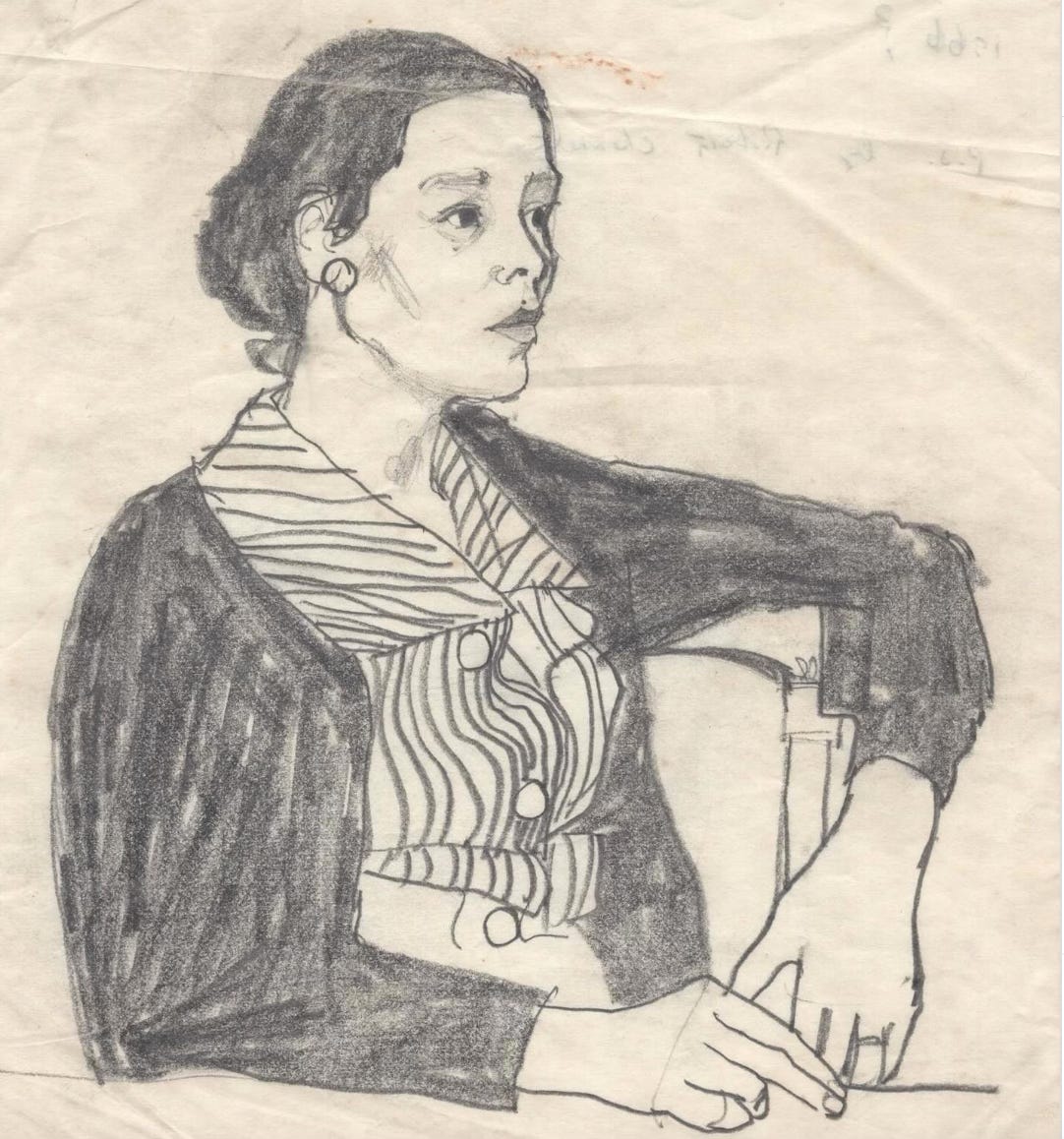
So I’ve got reams of drawings, mostly of the back of people, which is quite interesting. Whenever I teach a class, I have to take some drawings. That’s how my brain works.
Did Guruji, or Geeta, ever comment on that? Were they interested in what you were doing?
I remember at some point I was permitted to help in the medical classes. If you were at a certain level of certification, you could do that. There might be three people working on one person, and then Guruji would come around. These were amazing learning situations. I remember drawing some sequence in the medical class and Guruji looking a bit, well, like he wasn’t quite sure what to make of it, because I was just drawing, and drawing, and drawing. But he didn’t stop me.
One of my fondest memories of Guruji—and I’ve told this story before—is one time when we were in Pune burning the midnight oil, decorating the Institute for a celebration—there were always celebrations. I had a team. We had colored paper, and glue, and we were pulling everything together.
We could tell Guruji was over in his house, on the other side of the courtyard, because the light was on. First, he sent tea for all of us. Then, he came over to see what was going on. I’m on the floor, cutting and pasting figures [of people in asanas]. And suddenly there’s a pair of feet in front of me, and you follow the pair of feet up, and it’s Mr. Iyengar. And he starts to correct the drawings, like “the knee should turn in a little bit more, and the foot should turn that way.” He was having so much fun, collaborating. In a moment, he could skip from being a yoga master to being an art director. It was wonderful having him around, having him contribute, and having him be enthusiastic.
Geeta must have appreciated your drawing as well, not to mention your teaching, since she wrote the introduction to The Women’s Yoga Book. How did that come about?
I wrote to Geeta and said, “I’ve written this. I don’t think it’s fair of me to ask you to edit it, but could you write me an introduction?” So, I FedExed it over and she wrote a lovely introduction. And I’m very blessed. It means I had their blessing.
Now, there’s a lot I’d change in the book if I could. I know more now, and there are a lot of things we do differently in the teaching of certain asanas. But doing a book takes over your life, it takes 10 years. I don’t think it’s going to happen again.
One of my favorite Guruji quotes is “Yoga teaches us to cure what need not be endured and to endure what cannot be cured,” which touches on what you were saying earlier about his approach to suffering. Having your husband develop dementia and having had other losses in your life, including your friend Brooke Myers who has Alzheimer’s—I’m making the assumption that your practice has given you a perspective on losing somebody in that way, which you might not otherwise have.
Yes. Absolutely. But I think part of it is that I was not brought up in a particularly easy household. There was a certain amount of struggle going on, because my mother brought the three of us up on her own. My father wasn’t around much, and then he left when I was around 10. And it was difficult in England because there was a sort of taboo—if you were a woman struggling on your own, you were a figure of pity. It was your fault and it was shameful. And the British class system seemed to be something that caused my mother a lot of pain. But she just kept on going and did what you have to do.
More and more, I think that that may have shaped me. I accept whatever life throws at me, I just think that’s normal. And if nice things come my way, I think, “Oh wow, that’s nice.”
I also have as part of my life the idea of duty. Geeta talked a lot about duty. The Bhagavad Gita talks a lot about duty, and I believe anything that comes out of the Bhagavad Gita, even if I don’t always understand it. That helps me, that sustains me. I don’t feel like the world has done me wrong because my husband has Alzheimer’s and I’m having to do a lot of stuff. I’m just doing it.
But I will say this: don’t marry anyone who you’re not prepared to take care of when they get Alzheimer’s. If you want the family and the kids or whatever it is, then old age is part of the package.
What does this turning point—having left New York, the Institute and returning to England—feel like for you?
It feels right. Eight years ago, we bought an apartment in New York, and it might’ve been more sensible to not have gone through the whole hassle and just go straight back to the UK where we already had a house. But I wasn’t ready, and I didn’t want to go. I still had work to do here.
And these last years have been an amazing time. I wouldn’t have missed it. But now it’s time. It’s appropriate. And I’m ready. I want it. I think it’ll come over me in waves because my life in New York meant my feet didn’t touch the ground. I was just kept aloft either by the energy of the city or my place at the Institute or the people around me and my students.
But I don’t want to be this busy. I have to go and find peace. There’s a stage which I’m almost too late for—because I’m 82—which is more of an introspective time. I want to be able to do my own practice, and protect that.
You’ve talked in classes about how your practice has changed over time, and that you usually start with a 20-minute supta virasana—you called it “your heaven.” What else do you focus on?
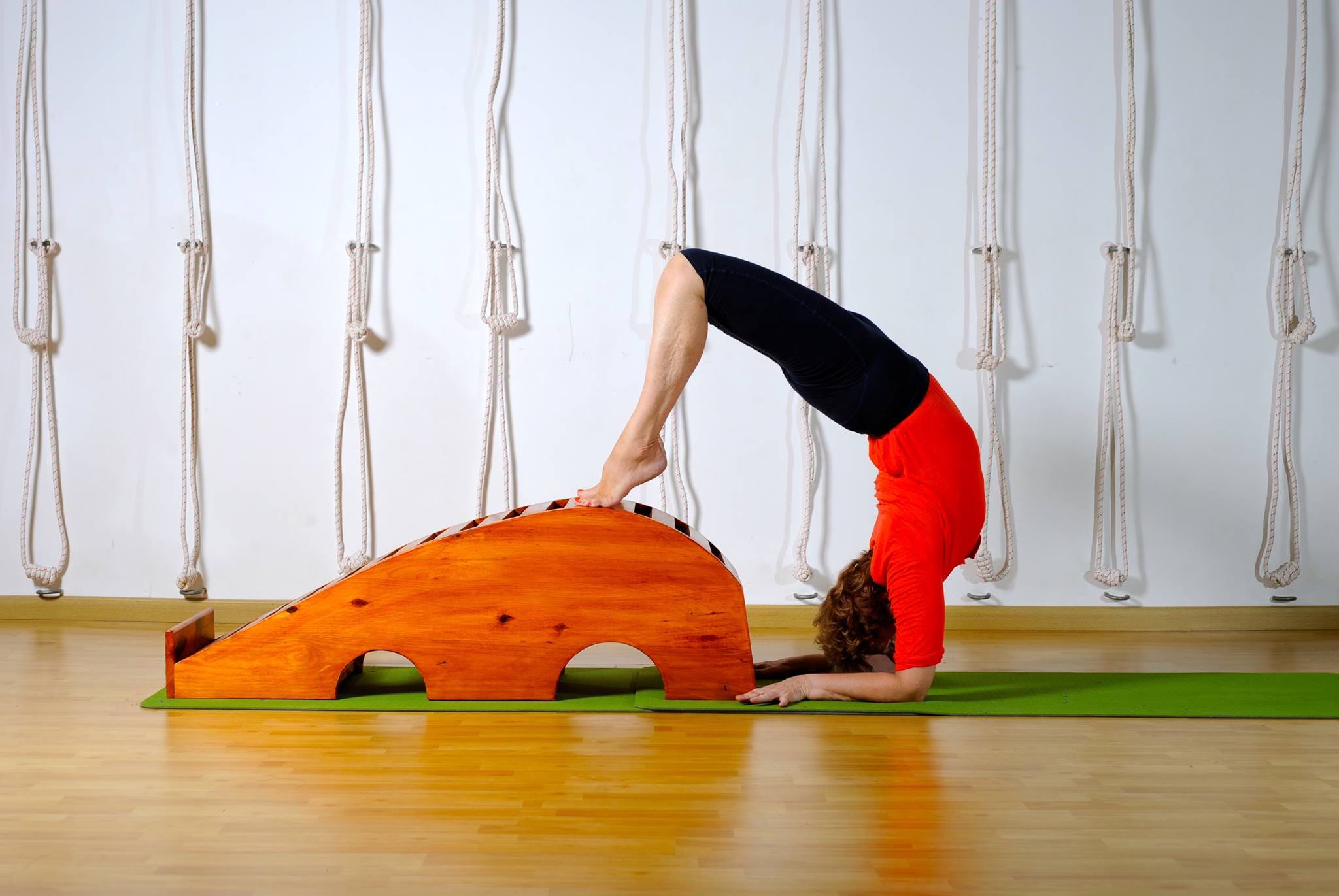
Well, I’m not as strong as I was, so I have to incorporate that. I don’t stand on my head for half an hour anymore. In the beginning, we didn’t know any better—we thought we were supposed to stand on your heads for half an hour because that’s what Guruji used to do. I really learned inversions just by being in proximity to him.
Now, 15 minutes is my max. And I love doing it with the support of blocks. And I love hanging upside down. I don’t push up off the floor in urdhva dhanurasana anymore. I can push off the wall, or I can push up off a chair, so I do that.
I love my forward bends. And shoulder stand with a chair. Because the inversions are a good way to keep your immune system and nervous system strong.
What about this new chapter in the UK are you most looking forward to?
I think life in New York encroached on my practice. It’s hard to push the world away. But I want my mornings back. I want to get up and know that the morning is mine, that nobody’s coming at me. I want my pranayama. I want all that to be more important than everything that’s demanded of me. I think that’s the right thing for 82.
*For a full list of Bobby’s publications, visit www.bobbyclennel.com.